Can I Travel With Weed on a Plane?
Traveling with marijuana remains illegal under federal law in 2026, regardless of state-level legalization or medical status.
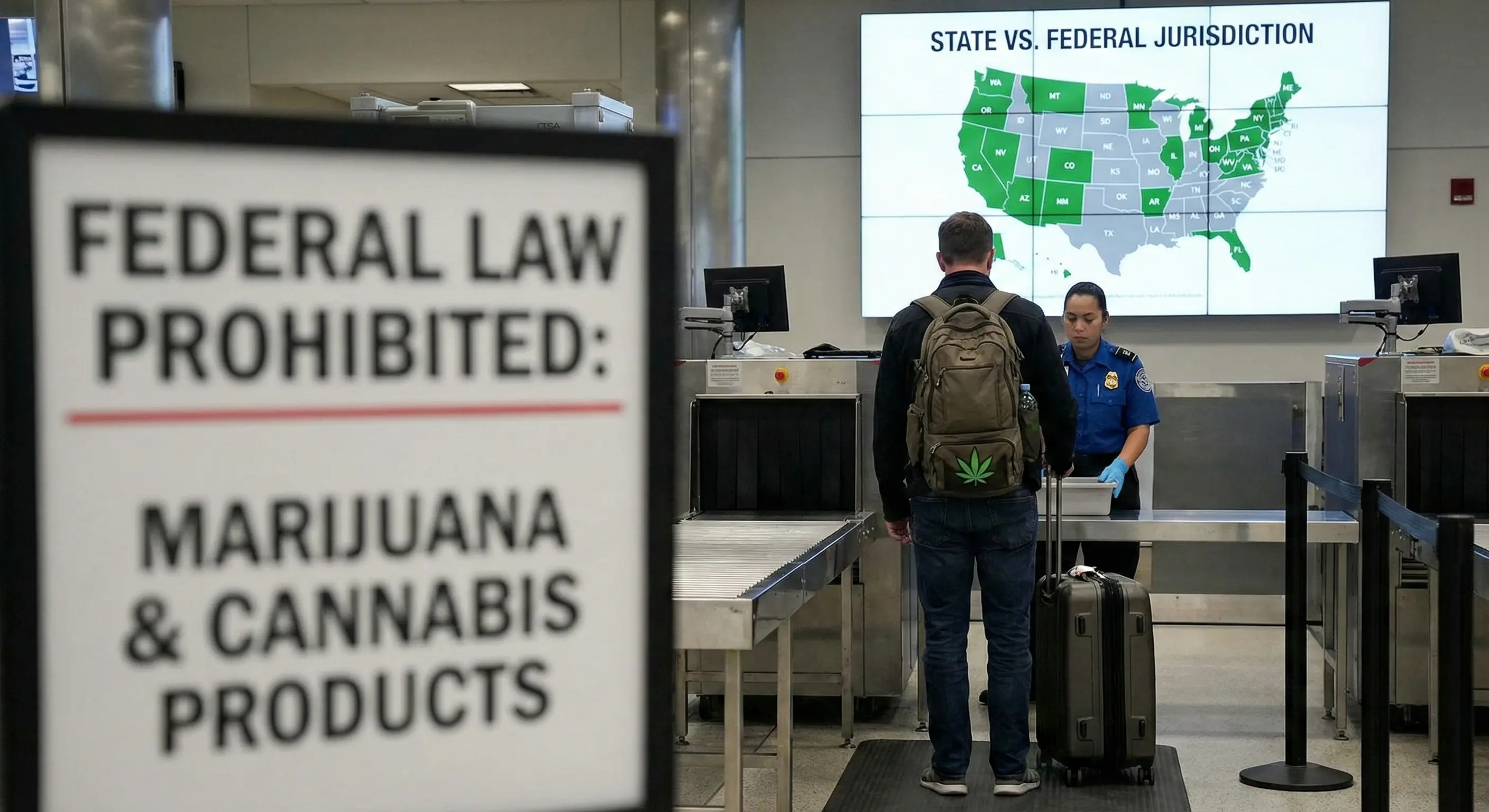
<h1>Flying with Marijuana: A Guide to Federal and State Laws</h1> <p>Traveling with marijuana on a plane remains <strong>illegal under federal law</strong> in the United States, regardless of state-level legalization. Airports and aircraft fall under federal jurisdiction, where cannabis is classified as a Schedule I controlled substance under the Controlled Substances Act. This means that even if you are traveling between two states where recreational or medical marijuana is legal, the moment you enter federal jurisdiction at the airport, state laws no longer provide protection.The Legal Conflict: Federal vs. State Laws</p> <p>Traveling with cannabis by air is a high-risk activity because you are subject to <strong>federal law</strong> the moment you enter the airport's federal jurisdiction, such as a TSA checkpoint. The Federal Aviation Administration (FAA) and Transportation Security Administration (TSA) operate under federal rules.</p> <ul><li><strong>Federal Law Prevails:</strong> Even when traveling between two <strong>legal states</strong>, state laws offer no protection at the airport.</li><li><strong>The Risk of Interstate Travel:</strong> Crossing state lines or entering federal airspace with the substance can lead to <strong>criminal charges</strong>, including drug possession or trafficking.</li></ul> <h2>The Role of the TSA and Law Enforcement</h2> <p>The <strong>Transportation Security Administration (TSA)</strong> primarily screens for weapons and explosives, not specifically for drugs. However, if a TSA officer discovers <strong>marijuana</strong> or cannabis-infused products during a routine screening, standard operating procedure requires them to:</p> <ol><li><strong>Report the Violation:</strong> Notify local, state, or federal authorities of any suspected violation.</li><li><strong>Refer to Law Enforcement:</strong> A law enforcement officer will then determine how to proceed based on the <strong>local jurisdiction and state laws</strong>.</li></ol> <p>Example Scenarios</p> <p>Scenario</p><p>Location</p><p>Legal Status & Consequence</p><p><strong>Legal State Departure</strong></p><p>Denver International Airport (Colorado)</p><p>Local officers may ask the traveler to dispose of the product in an "amnesty box." Result: <strong>Significant delays and a missed flight</strong>.</p><p><strong>Interstate Travel Risk</strong></p><p>Los Angeles to Chicago</p><p>Traveler is in <strong>violation of federal law</strong>. If the flight diverts to a strictly illegal state (e.g., Indiana), the passenger could face <strong>state-level criminal charges for possession upon landing</strong>.</p> <h2>Potential Consequences of Being Caught</h2> <p>The penalties for being caught with marijuana at an airport vary significantly depending on the jurisdiction and the quantity involved.</p> <ul><li><strong>In states where marijuana is strictly prohibited:</strong> Immediate arrest, <strong>heavy fines</strong>, and a permanent criminal record.</li><li><strong>In "legal" states:</strong> Travelers may still be subject to <strong>citations</strong> or the <strong>seizure of their product</strong>, as local airport ordinances can be restrictive.</li><li><strong>Federal Consequences:</strong> A federal conviction can result in:</li><li>Loss of federal benefits.</li><li>Significant jail time for larger quantities.</li><li>A permanent "red flag" on travel profiles, complicating future air travel and participation in programs like TSA PreCheck or Global Entry.</li></ul> <h2>The Safest Approach to Air Travel with Cannabis</h2> <p>The most reliable way to navigate the legal complexities is to <strong>avoid carrying any cannabis products containing more than 0.3% THC</strong>.</p> <ul><li><strong>Do Not Transport:</strong> <strong>Purchase your supply from a licensed dispensary at your destination</strong> rather than risking confiscation, fines, or arrest.</li><li><strong>Understand Federal Jurisdiction:</strong> You are subject to <strong>federal law</strong> the moment you enter the security checkpoint.</li></ul> <h2>Traveling with CBD and Hemp Products</h2> <p>Federally legal, <strong>hemp-derived CBD products</strong> are permissible, provided they meet strict criteria:</p> <ul><li><strong>THC Content:</strong> Must contain <strong>less than 0.3% THC</strong>.</li><li><strong>Documentation:</strong> Keep the product in its original packaging with accessible lab results or a Certificate of Analysis (COA).</li><li><strong>TSA Liquids Rule:</strong> For CBD oils or tinctures in a carry-on, you must strictly adhere to the TSA’s <strong>3-1-1 liquids rule</strong> (containers 3.4 ounces or smaller, placed in a single, quart-sized clear plastic bag).</li></ul> <p>Always prioritize <strong>discretion and compliance</strong> with all regulations. Remember, TSA officers are required to refer any suspected violations to law enforcement.</p>