Do you like weed? The government wants to take your guns away
On March 2, 2026, the Supreme Court will hear United States v. Hemani to decide if the federal ban on firearm ownership for marijuana users violates the Second Amendment. The DOJ argues habitual drug users are dangerous, appealing a Fifth Circuit ruling that found no historical basis to disarm sober cannabis users. This upcoming decision will determine the gun rights of millions of Americans who use marijuana.
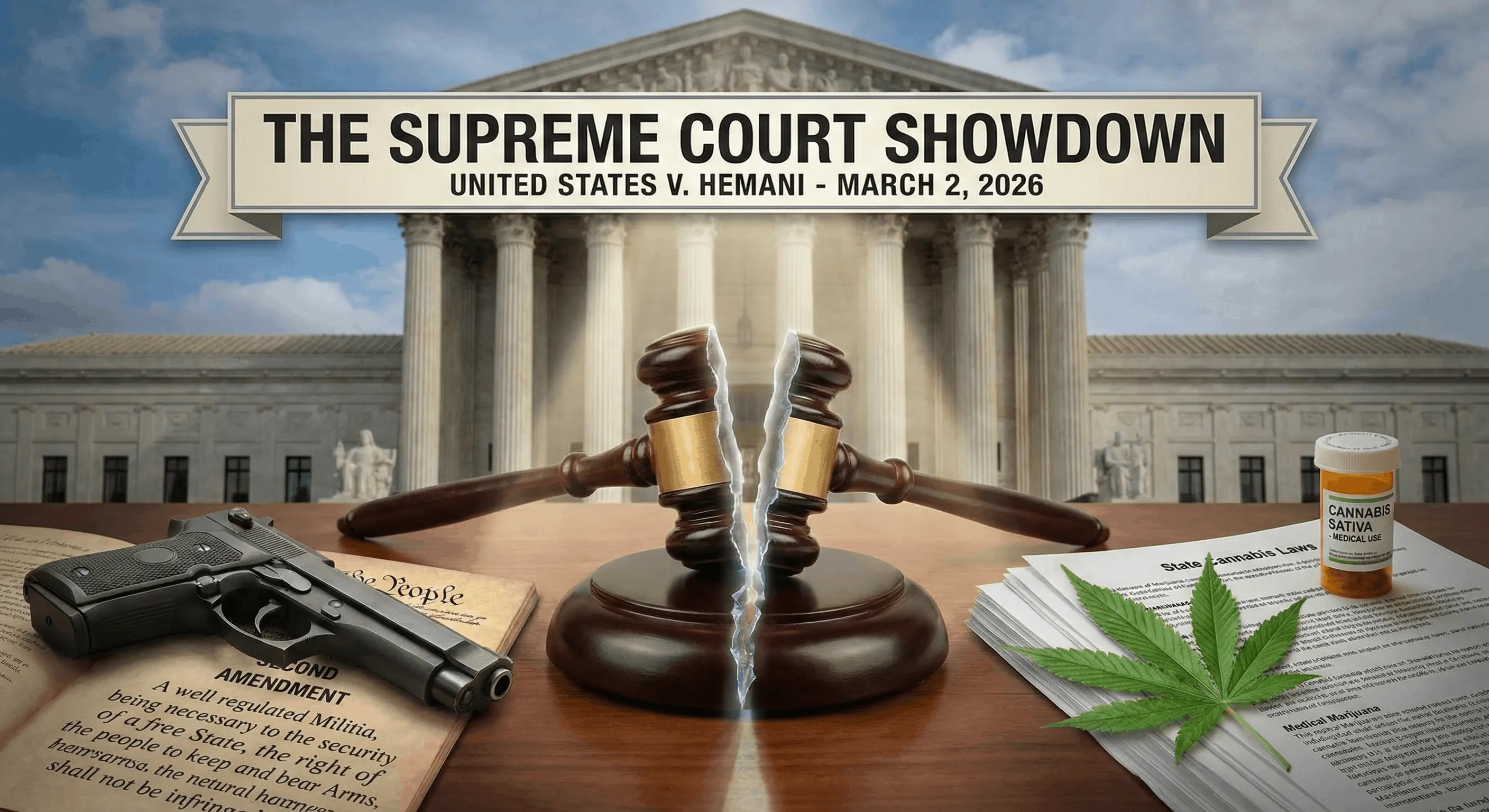
<h1>The Supreme Court Showdown Over Cannabis Users’ Second Amendment Rights</h1> <p><strong>I. Introduction</strong></p> <p>For decades federal law has treated marijuana as a dangerous drug with no accepted medical value. That classification not only makes cannabis illegal at the federal level, it also subjects people who use marijuana — even in states where it’s legal — to other punitive consequences. One of the harshest is a decades-old ban on possessing firearms. Under federal statute 18 U.S.C. § 922(g)(3), “unlawful users” of controlled substances may not own or buy guns. The U.S. Supreme Court will soon decide whether that prohibition violates the Second Amendment when applied to people who use marijuana but are otherwise law-abiding.</p> <p><em>II. The Case: </em>United States v. Hemani*</p> <p>This high-stakes case, <strong>United States v. Hemani</strong>, pits the Justice Department against Ali Danial Hemani, a joint American-Pakistani citizen who lawfully bought guns in Texas. FBI agents later searched his home and found a pistol, about 60 grams of marijuana and several grams of cocaine. He was charged under § 922(g)(3). A federal district court dismissed the charge, and the U.S. Court of Appeals for the Fifth Circuit agreed, finding no historical tradition of disarming people simply for using marijuana. Now the Supreme Court will weigh the government’s appeal.</p> <p>With oral arguments scheduled for <strong>March 2, 2026</strong>, this case has become a lightning rod for debates about drug policy, gun rights and federalism.</p> <p><strong>III. The Federal Law: What Does § 922(g)(3) Say?</strong></p> <p>Section 922(g)(3) of the Gun Control Act of 1968 makes it a felony for anyone “who is an unlawful user of or addicted to any controlled substance” to ship, transport, receive or possess firearms. The statute does not define “unlawful user.” The Justice Department has long interpreted the term broadly: if a person regularly uses marijuana or other illegal drugs, even without being intoxicated when carrying a gun, the person is disqualified from possessing firearms. Because marijuana remains illegal under federal law, this interpretation effectively disarms millions of Americans who use cannabis medicinally or recreationally.</p> <p>Civil liberties lawyers and gun-rights groups argue the statute is vague and overbroad. The American Civil Liberties Union notes that the government doesn’t have to prove someone was under the influence while possessing a gun, and the term “habitual user” is undefined. This invites arbitrary enforcement and criminalizes veterans and patients who use medical marijuana to treat pain. The Fifth Circuit held that history does not support disarming sober people for prior drug use and that the government must prove actual dangerousness at the time of possession.</p> <p><strong>IV. The Justice Department's Position: Cannabis Users Are Categorically Dangerous</strong></p> <p>In its reply brief to the Supreme Court, the Justice Department insists that habitual drug users are categorically dangerous and may be disarmed consistent with the Second Amendment. Trump-appointed Solicitor General D. John Sauer argues that Congress has a long tradition of disarming “dangerous” individuals, including habitual drunkards. He likens marijuana users to that category and says courts should defer to Congress and the executive branch in determining drug schedules. According to the brief, cannabis remains a Schedule I substance with a “high potential for abuse” and no accepted medical use, and its use therefore justifies disarmament. Even if marijuana is later moved to Schedule III, Sauer says, it will still be considered a drug with abuse potential, and past use will still trigger the § 922(g)(3) prohibition.</p> <p>The government contends that millions of Americans also abuse opioids and cocaine; just because marijuana is widespread does not mean its users are harmless. It stresses that the Controlled Substances Act leaves questions about a drug’s dangers to the executive branch, so courts should not second-guess Congress’s decision to bar cannabis users from possessing firearms.</p> <p><strong>V. The Impact of Trump's Order to Reschedule Marijuana</strong></p> <p>In December 2025, former President Donald Trump signed an executive order directing the attorney general to <strong>expeditiously finalize</strong> a rule to move marijuana from Schedule I to Schedule III of the Controlled Substances Act. The order acknowledged that marijuana has <strong>accepted medical uses</strong> and said rescheduling would improve research into medical cannabis and CBD products. The Justice Department has proposed reclassifying marijuana to Schedule III, a category for drugs with a lower abuse potential, but the rulemaking process is not yet complete. The White House order does not decriminalize marijuana; it simply directs the DOJ to finish the administrative process.</p> <p>Sauer’s brief points out that the executive order does not change current law. Cannabis remains a Schedule I substance until the rule is finalized. Even if the rescheduling happens before the Supreme Court’s decision, Sauer argues that marijuana’s abuse potential still warrants the gun ban. Critics note the irony: the same administration urging courts to treat marijuana users as dangerous is simultaneously promoting medical research and acknowledging marijuana’s therapeutic value.</p> <p><strong>VI. Growing Conflict: The Circuit Split on § 922(g)(3)</strong></p> <p>Federal appeals courts have reached different conclusions about the constitutionality of § 922(g)(3), creating a circuit split that almost forced the Supreme Court to intervene.</p> <ul><li>In <strong>United States v. Connelly</strong> (2024) and <strong>United States v. Daniels</strong> (2023), the Fifth Circuit held that the government must show a person was intoxicated at the time of gun possession to disarm them.</li><li>In <strong>United States v. Cooper</strong> (2025), the Eighth Circuit found no historical support for disarming someone solely because they belong to a class of drug users.</li><li>Other circuits have reached narrower or opposite conclusions. The Third Circuit requires <strong>individualized findings of dangerousness</strong>, not categorical bans, when applying § 922(g)(3).</li><li>The Sixth and Seventh Circuits have allowed the government to disarm drug users but questioned the statute’s breadth.</li><li>In August 2025, the Eleventh Circuit sided with medical marijuana patients, finding that disarming them conflicts with the nation’s history and Florida’s constitutional medical marijuana program.</li></ul> <p>These conflicting rulings underscore why the Supreme Court’s decision in <em>Hemani</em> will have nationwide implications.</p> <p><strong>VII. Key Players: States and Interest Groups Line Up</strong></p> <p>The case has drawn a diverse array of amici briefs.</p> <ul><li><strong>Upholding the Ban:</strong> Nineteen states and Washington, D.C., along with gun-control groups like Everytown for Gun Safety and Brady, urge the Court to uphold the federal gun ban. They argue that habitual drug users pose risks similar to habitual drunks and that Congress’s prohibition is a reasonable public safety measure.</li><li><strong>Challenging the Ban:</strong> Libertarian think tanks such as the Cato Institute, gun-rights organizations like the National Rifle Association and the Second Amendment Foundation, and civil liberties groups including the ACLU argue the ban is historically unprecedented. The Cato Institute contends that the government’s interpretation is <strong>“ahistorical, vague, and far too broad”</strong> and threatens to strip one-fifth of American adults of their gun rights. The Liberty Justice Center notes that nearly 64 million Americans used cannabis in the last year and warns that strict enforcement of § 922(g)(3) would criminalize tens of millions of otherwise lawful gun owners.</li></ul> <p><strong>VIII. ATF’s New Rule Clarifies “Unlawful Users”</strong></p> <p>Amid the legal battles, the Bureau of Alcohol, Tobacco, Firearms and Explosives (ATF) issued an <strong>interim final rule</strong> in January 2026 clarifying who counts as an “unlawful user.” The rule defines an unlawful user as someone who <strong>regularly uses a controlled substance over an extended period of time continuing into the present</strong> without a valid prescription. Isolated or sporadic use, such as a single instance within the past year, does not automatically disqualify someone. However, evidence of repeated use may still bar a person from possessing firearms even if they were sober at the moment they sought to buy a gun. The ATF says the rule aligns its definition with recent court interpretations and aims to ensure that only regular and recent drug users are prohibited.</p> <p><em>IX. Why </em>United States v. Hemani<em> Matters</em>*</p> <p>The Supreme Court’s decision in <strong>United States v. Hemani</strong> will determine whether law-abiding citizens who consume cannabis can exercise their Second Amendment rights.</p> <ul><li><strong>If the Court Upholds the Ban:</strong> Millions of Americans — including medical patients using marijuana legally under state law — could lose their right to own or carry firearms.</li><li><strong>If the Court Strikes Down or Narrows the Statute:</strong> It would open the door for legal challenges to other federal prohibitions that hinge on drug use.</li></ul> <p>This case also highlights the tension between evolving state cannabis laws and outdated federal prohibitions. Thirty-eight states and D.C. have legalized marijuana for medical or recreational purposes. Yet federal law continues to treat cannabis users as criminals and strips them of constitutional rights. As the Cato Institute points out, the government’s position is inconsistent with its own acknowledgment of medical marijuana in Trump’s rescheduling order. Whether the justices will reconcile these contradictions remains to be seen.</p> <p><strong>X. Conclusion: The Question of Constitutional Rights for Cannabis Users</strong></p> <p>At its core, <strong>United States v. Hemani</strong> asks whether the federal government can label millions of ordinary Americans as “dangerous” and disarm them simply because they use cannabis. The Justice Department says yes, citing centuries-old prohibitions on armed drunkards and the still-illegal status of marijuana. Opponents say no, arguing that there is <strong>no historical analogue</strong> for disarming sober citizens based on a personal habit and that the government’s position is at odds with its own push to recognize cannabis’s medical benefits. In early March, the Supreme Court will hear arguments that could reset the balance between gun rights and drug policy for decades to come.</p> <p>As you watch the case unfold, remember: what happens in Washington will determine whether enjoying a joint means giving up your guns.</p>